
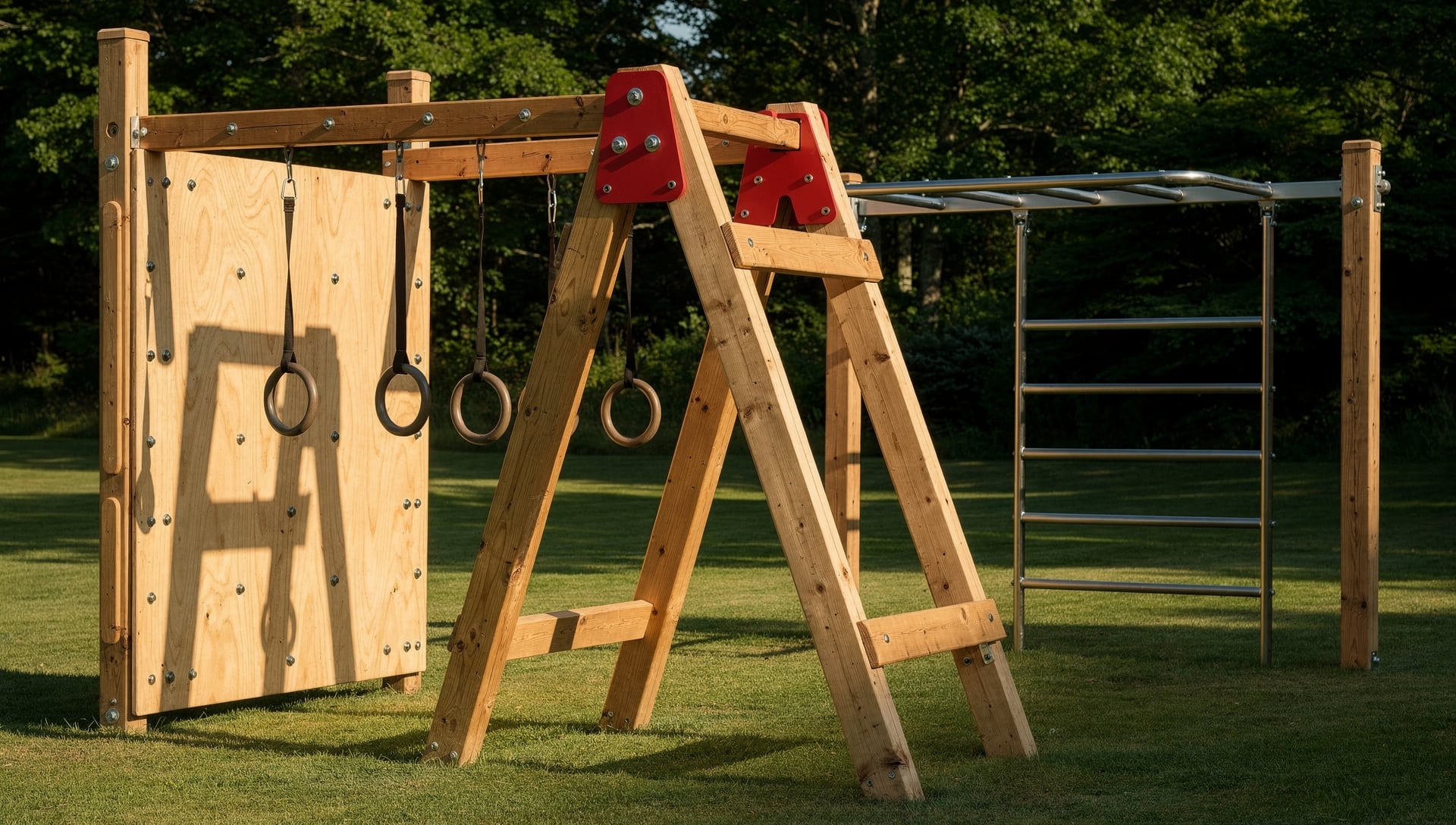
A real backyard ninja warrior course is a custom build, not a kit you screw together on a Saturday. Done right, it sits on concrete footings, framed with pressure-treated lumber, through-bolted with galvanized hardware, and laid out with a safe fall zone under every obstacle. That is why the parents who call us are not looking for the cheapest option. They are looking for someone they trust to build something a kid will swing on for years.
Last spring a dad in Windham called about his daughter's sixth birthday. She had watched Ninja Warrior all winter and wanted her own course in the backyard. Not the plastic thing from the big box store. A real one, with a warped wall and monkey bars, that she could grow into. He had one question before anything else. Can you build it so I never have to worry about it holding her weight.
That question is the whole job. Anybody can screw some boards together. Building something a child hangs from, drops off of, and races across a hundred times a summer is a different thing. Here is how we do it, and what to ask any builder before you hand them a wild idea and your kid.
Why a backyard ninja course is a real construction project
The forces on a ninja course are bigger than people expect. A kid swinging across monkey bars puts a shock load on the beam and the posts every time she reaches for the next rung. Grab that with posts pounded into the dirt and the whole thing racks and loosens by August. We set the posts in concrete footings below the frost line, the same way we set a deck, so nothing shifts through a New Hampshire winter.
- Pressure-treated or cedar posts set in concrete footings, dug below the frost line so frost heave cannot lift them.
- Beams sized for real shock loads, not just for the weight sitting still.
- Through-bolted galvanized or stainless hardware, never deck screws in end grain.
- Every edge eased and sanded, every bolt end capped, no splinters and no snag points.
Sized for a 6-year-old, built to grow
We set her monkey bars low enough that her feet clear the ground by a safe margin, and her warped wall short enough that a six-year-old can actually run it and feel like a champion. Then we framed the posts tall and the footings strong enough to raise the bars and add obstacles as she grows. The course she runs at six is the base of the course she runs at twelve. You are not buying a toy she outgrows in a year. You are building the frame she grows into.
The obstacles we built for her
- A warped wall at kid height, with a grab ledge she can actually reach on the run.
- Monkey bars with the rungs spaced and angled for small hands, not adult reach.
- A cargo net she can scramble up and a rope to come down.
- A balance beam and a set of stepping pods at a couple of heights.
- A pair of hanging rings to finish, low enough for a soft drop to the landing.
The part nobody sees: fall zones and a safe landing
Here is the part that separates a real build from a backyard hazard. Every obstacle needs a clear fall zone and a soft surface under it. Public playground safety guidance from the CPSC calls for the protected area to extend at least six feet in every direction from the equipment, over a cushioned surface, because a fall onto packed dirt or a thin patch of grass is where kids get hurt. We plan the layout so the fall zones do not overlap into a fence, a tree, or each other, and we build a proper landing under the whole course.
- A cushioned surface under the course: engineered wood fiber, rubber mulch, or poured-in-place rubber.
- Loose-fill surfacing built up to a real depth, roughly six inches for these heights, not a token layer.
- Edging to hold the surfacing in place and drainage so it does not turn to soup after a storm.
- Six feet of clear fall zone around each obstacle, planned before a single post goes in.
Built for New Hampshire, not just for July
A course built in June has to survive February. Frost heave lifts anything that is not footed below the frost line. Sun and rain grey out cheap lumber and rust cheap hardware in a single season. We use pressure-treated or cedar, galvanized or stainless fasteners, and footings deep enough that the whole thing sits exactly where we left it when the snow melts. Southern New Hampshire winters are the real test, and we build for the test.
What it costs, and what you are really paying for
A real custom course costs more than a kit and less than a lot of people fear. The number depends on how many obstacles, how big the footprint, and what surfacing you want under it. What you are paying for is the stuff you cannot see in the finished photo: the footings, the hardware, the fall zones, and a builder who stands behind it. We walk your yard, talk through what your kid actually wants, and put the whole number in writing, line by line, so you can see exactly what you are paying for before you decide.
“She ran it forty times the first afternoon and I did not flinch once. That is exactly what I was paying for.”
Dad in Windham NH, Dream Builds client
The fun stuff is the easy part
A ninja course, a treehouse with real lights wired to it, a bookshelf that swings open to a hidden room. These are the builds we love the most, and they are still real construction. Same crew that frames the kitchens and decks, same footings, same standards, just a lot more fun. We call this lane Dream Builds, and it is exactly the kind of call we hope comes in.
If you have a wild idea for your yard or your house, call Tony at (978) 216-6455 and describe it, or book a free consultation. We will tell you straight what it takes to build it right, make it safe, and put it in writing. Bringing the wild idea is your only job. Building it sturdy is ours.
“Build it like you are going to let your own kid run it, because somebody is.”
Tony Squillini, Owner, Anjo Services, LLC
Next step
Ready to talk about your project?
Take the 6 question quiz to find your project, or schedule a free walkthrough. Tony does the walkthrough himself. Written quote, line by line.